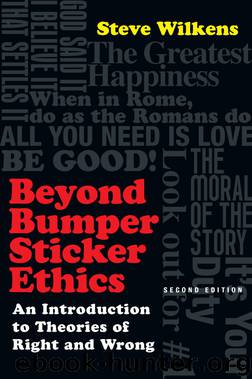
Beyond Bumper Sticker Ethics: An Introduction to Theories of Right and Wrong by Steve Wilkens
Author:Steve Wilkens [Wilkens, Steve]
Language: eng
Format: azw3
Publisher: InterVarsity Press
Published: 2011-09-02T04:00:00+00:00
Positive Aspects of Kantian Ethics
While some see the abstract nature of Kant’s ethics as a negative, others are hesitant about his theory for a different reason. The heavy emphasis on words like duty and rules gives his system a dry and dreary feel. However, these very terms are what attract others to Kant’s system, and for good reason. Duty takes us back to the intuition that some things are right no matter what. It helps anchor morality so that we are not swayed by changing moods and emotions, or sidetracked by unpredictable consequences. We court danger when the basis of our choices is arbitrary and changeable. Relying on the concept of duty seems like a good way to avoid that danger.
Rules can be aggravating because they illuminate our shortcomings. Because a law like “do not steal” has an objective status that separates it from our emotions and wants, it does not care how we feel about stealing. This detachment can be of great benefit if we are interested in knowing what is true. We often fight a battle between what we would like to be true and what is actually true. We do not always want “do not steal” to be true. Thus, as Kant points out, our desires may blind us to what is right. His system tries to take us beyond the nonethical question, What do I want? to the ethical issue, What is right? and this seems to move us in the right direction.
Furthermore, if ethical truth is truth in the normal sense of the word, we have to acknowledge that ethical beliefs are either right or wrong. Mathematicians and scientists do not see truths in their fields as something that can be compromised. They might change their beliefs about what is true when it is reasonable to do so, but the universe itself does not change. All that has changed is their view of it. Kant says the same thing is true about ethics. Ethical laws are not open to negotiation. It is possible to hold unreasonable beliefs about ethics, but this is a problem with our understanding of right and wrong, not a problem with right and wrong itself. This is why Kant’s ethics has so much appeal to people who are not simply looking for a way to justify what they want to believe, but who really want to know what is right.
Another positive point follows from this. Irrationality can be frightening when it comes to ethics, so there is merit in stating that ethics should be rational. Most people are willing to accept the authority of reason, at least in theory. We may disagree about what is reasonable, but people generally seem to agree that of two conclusions, the one with better reasons to support it is the better conclusion. Therefore, it is difficult to disagree with Kant’s assertion that an ethical conclusion that can be rationally supported is preferable to one that is not rationally supported.
Moreover, Kant connects rationality with the universalization of categorical imperatives in a way that coincides with the moral intuitions of many people.
Download
This site does not store any files on its server. We only index and link to content provided by other sites. Please contact the content providers to delete copyright contents if any and email us, we'll remove relevant links or contents immediately.
The Secret Power of Speaking God's Word by Joyce Meyer(3220)
Signature in the Cell: DNA and the Evidence for Intelligent Design by Stephen C. Meyer(3138)
Real Sex by Lauren F. Winner(3023)
The Holy Spirit by Billy Graham(2952)
The Gnostic Gospels by Pagels Elaine(2531)
Jesus by Paul Johnson(2362)
Devil, The by Almond Philip C(2332)
23:27 by H. L. Roberts(2251)
The Nativity by Geza Vermes(2230)
Chosen by God by R. C. Sproul(2164)
All Things New by John Eldredge(2162)
Angels of God: The Bible, the Church and the Heavenly Hosts by Mike Aquilina(1969)
The Return of the Gods by Erich von Daniken(1946)
Angels by Billy Graham(1926)
Knowing God by J.I. Packer(1859)
Jesus of Nazareth by Joseph Ratzinger(1811)
The Gnostic Gospel of St. Thomas by Tau Malachi(1799)
Evidence of the Afterlife by Jeffrey Long(1790)
How To Be Born Again by Billy Graham(1782)
